Modular Cleanroom Walls for Automotive Paint and Battery Manufacturing: Controlling Contamination at Scale
Contamination Control Becomes Critical in Automotive Manufacturing
The automotive industry's shift toward electric vehicles has introduced contamination sensitivity levels previously unseen outside semiconductor and pharmaceutical manufacturing. Battery electrode coating, cell assembly, and module integration demand particulate control that traditional automotive plants were never designed to provide. Modular cleanroom walls enable OEMs and tier-one suppliers to create ISO Class 7 and Class 8 environments within existing factory footprints without the twelve-month construction timelines that would delay production launch programs.
Paint shops have long required controlled environments, but the defect tolerance for visible surface imperfections on premium vehicle bodies has tightened to fewer than three inclusions per unit. Each particle landing on wet paint during the clearcoat application creates a repair loop that costs labor, material, and throughput. Clean room wall systems enclosing the spray booth perimeter and flash-off zones reduce airborne particulate ingress from adjacent assembly operations, directly lowering defect rates and the associated rework burden that erodes margin on every vehicle.
For program managers building business cases, understanding modular clean room cost relative to quality savings is essential. A typical EV battery plant investing in modular cleanroom enclosures for electrode coating and cell stacking zones reports defect rate reductions of 40 to 60 percent within the first production quarter. At scrap costs exceeding 200 dollars per rejected cell, the payback period for the cleanroom investment frequently falls below eighteen months.
Material Selection for Automotive Cleanroom Wall Applications
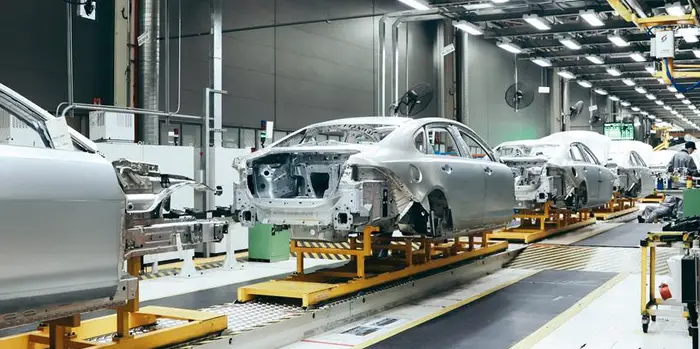
Automotive manufacturing environments impose mechanical demands that pharmaceutical and electronics cleanrooms rarely encounter. Forklift traffic, overhead crane operations, and the vibration from adjacent stamping presses require fiberglass wall panels or steel-faced panels with impact-resistant cores that maintain surface integrity despite incidental contact. A dented or punctured panel face in a battery assembly zone creates particle generation points that undermine the very contamination control the enclosure was built to provide.
The modular cleanroom system for automotive applications must also accommodate large equipment penetrations. Conveyor openings for body-in-white transfers, robotic arm pass-throughs, and overhead utility drops require custom frame assemblies that maintain air seals around moving components. Brush seals, strip curtains, and air knife barriers at these penetrations prevent unfiltered air infiltration while allowing continuous material flow through the production sequence.
Each cleanroom wall panel in an automotive paint environment must resist overspray accumulation and solvent exposure from cleaning cycles. PVDF-coated or polyester powder-coated faces withstand the ketone and ester solvents used to remove paint buildup without surface degradation. Panels in battery manufacturing zones face a different chemical profile: NMP solvent vapor from electrode coating and electrolyte exposure risks from cell filling operations require chemical-resistant face materials and sealed core interfaces.
Scaling Cleanroom Construction Across Multi-Plant Programs
Global automotive groups operating ten or more assembly plants face the challenge of standardizing cleanroom specifications across diverse geographic locations with varying contractor capabilities. Modular construction solves this by centralizing manufacturing quality at the panel factory while reducing on-site work to bolt-together assembly. A modular cleanroom system designed once and replicated across plants ensures consistent cleanliness performance regardless of local construction labor quality.
Standardization also simplifies spare parts logistics. When every plant uses identical modular cleanroom walls with interchangeable panel dimensions and joint hardware, regional maintenance warehouses stock a single SKU set rather than managing unique components for each facility. This commonality reduces inventory carrying costs and eliminates the multi-week lead times that occur when a damaged panel in one plant requires a custom fabrication run from the original supplier.
As automotive electrification accelerates and battery production capacity expands globally, the manufacturers who deploy modular contamination control earliest will achieve yield advantages that compound over millions of cells. The clean room wall systems enclosing today's pilot lines will define the quality benchmarks that competitors struggle to match at volume production scale.